







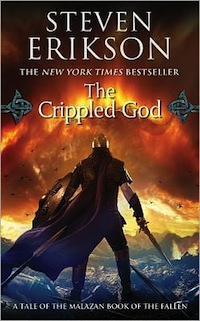
Welcome to the Malazan Reread of the Fallen! Every post will start off with a summary of events, followed by reaction and commentary by your hosts Bill and Amanda (with Amanda, new to the series, going first), and finally comments from Tor.com readers. In this article, we’ll cover chapter fifteen of The Crippled God.
A fair warning before we get started: We’ll be discussing both novel and whole-series themes, narrative arcs that run across the entire series, and foreshadowing. Note: The summary of events will be free of major spoilers and we’re going to try keeping the reader comments the same. A spoiler thread has been set up for outright Malazan spoiler discussion.
CHAPTER SUMMARY
SCENE ONE
Yan Tovis fights in the Liosan battle, thinking Yedan has forged something new of her people and the Letherii, but none of them can keep up with him. She imagines him eventually standing alone. She sends Sharl to tell Sandalath the wall has shattered and only half the defenders remain. Sharl agrees to take the message, but not the ordered rest, saying she needs to return to her one surviving brother. Yan Tovis retracts her request and sends Sharl back to be by her brother. As Sharl departs, Yan Tovis muses on the legends that will be told of Yedan—ones that “none living will ever hear—the span of time itself must be crowded with such legends… What if that is the only true measure of time? All that only the dead have witnessed… All those stories forever lost. Is it any wonder we cannot grasp hold of the ages past? That all we can manage is what clings to our own lives… To all the rest, we are cursed to deafness.” She recalls her brother facing off against a dragon earlier.
SCENE TWO
Yan Tovis sees her brother holding the center, pushing forward. She heads for one of the flanks to give the soldiers hope and more—“this nectar of power rising within her.” As she fights she thinks of her brother and of how “we have never been as pathetic as we are at this moment… in our fate, trapped in our roles… Every freedom was a lie.” She sees a dragon strike the center, then watches Yedan behead it with his Hust sword. Where its blood struck, “black crystals pushed up from the drenched sand… to form faceted walls—and from every corpse… ghostly forms now rose, struggling within that crystal. Mouths opened in silent screams.” Yedan, though, is protected from the blood by his sword. The Liosan drag the dragon’s body back so it doesn’t block the breach. The Liosan retreat and hold back, and Yedan tells his people “Shake! Tell me when you have come home—tell me when that truth finally comes to you. You are home!” But Yan Tovis is surprise by her brother’s own surprise at the answering roar of the Shake: “Brother, you do not feel it. You do not feel that you have come home. You do not feel as they do!… Oh Yedan, I did not know.”
SCENE THREE
Kadagar Fant looks for the third time at the corpse of Iparth Erule (the dragon). Aparal despairs at the number of Liosan killed on the other side, a thousand or more. He wonders when Fant will send in the elites, rather than use the “common dwellers of the city” as cannon fodder. He knows Fant cares less for taking Kharkanas than for “the absolute annihilation of those who opposed him. On both sides of the breach.” Her recalls when Kallor entered the throne room of Saranas to tell Fant’s father, the king, the Serap Issgin—Kallor’s wife and the king’s grandmother—killed herself. Despite it being a suicide, Kallor calls himself her murderer, arguing against “all that rot about selfishness and self-hatred. The lies we tell ourselves to absolve us of blame, of all the roles that we played in that wretched death.” He blames them as well, for how she had been “virtually a prisoner here—Arrived as a stranger, and as a stranger you were determined to keep her… You all had your parts to play in her death.” He says though he isn’t there to claim vengeance, as his own guilt is clear: “I could not love her enough. I can never love enough.” He has come because he’d promised her he’d bring a rag doll Serap had been making for her daughter when she’d fled and which he’d found on her lap “like a newborn child” after she’d killed herself (this information delivered as Serap’s daughter stands behind Kallor). He disarms himself, stating he is ready for their vengeance. But Krin, the king, tells him to just go. Aparal recalls the look on Kallor’s face had been that of a “man who wanted to die. [And] what did we do? We denied him.” Kallor had exited, pausing by Serap’s daughter, though none could tell if he spoke to her. Aparal remembers how four years later, Fant had sworn to have no children, that instead “all the Liosan would be” his children, and Aparal recalls laughing, and how that might have wounded Fant. Fant’s voice calls him out, asking him what he’d been thinking of, but Aparal lies. They agree the Hust wielder must be killed and when Fant asks how, Aparal answers, “When all the others have fallen, when he alone remains. When twelve dragons break through.”
SCENE FOUR
Sandalath sits on the throne hearing the laughter of ghosts and seeing visions. One is of Rake telling the Hust Legion they he will face the Eleint “beyond the Rent, to deny them the Throne of Shadow,” while they must pass through the Starvald Demelain Gate and hold them on the other side. And then the final five survivors must sacrifice themselves to seal it. Sandalath remembers how they never saw the Hust again, but also how the Eleint stopped coming. She wonders how many they killed at the Gate, though she knows now they come again, and knows as well Rake knew this day would come, that he’d been buying time. And thinks too how just before this new invasion, he had forced “her” [Mother Dark, I assume] to “face us again.”
SCENE FIVE
Withal hears Mother Dark tell him Sandalath is “lost in ages past” and warns him of despair. Withal asks Mother Dark what she expects, since Sandalath was made “ruler of an empty city.” She goes on to say Sandalath “was born a hostage to secret fates, born a hostage to a future she could not imagine, much less defy. In this… she symbolized every child.” Withal upbraids Mother Dark, telling her she/they never let Sandalath grow up, and Mother Dark agreed: “Yes, we would keep them children for ever.” He comes out to see Sandalath weeping over all the death: “They’re all dying Withal. On the Shore… The Hust Legion—I saw them marching out form the burning city… Their swords howled. Their armor sang with joy… The sound—so terrible—.” She recalls people fleeing, and how nobody therefore saw the Legion marching to its death. Withal slaps her, telling her the place is driving her crazy and that she has too many ghosts in her head filling her with foolishness. She tells him it’s the waiting for the inevitable death of them all, of Withal, herself. When he suggests the Andii will come she scorns the idea of them avenging her: “And so it goes on and on, back and forth. As if it all meant something.” And she swears to burn the place to the ground to make things different this time. When he points out there’s nothing to burn, she replies, “There are other ways to summon fire.”
SCENE SIX
Pithy fixes her sword, and says they should let Yedan know they need to do a better job of denying the Liosan the Letherii and Shake weapons they’ve been scavenging. The Hounds exit the barrier and attack.
SCENE SEVEN
Yan Tovis tries to kill a Hound. She fails.
SCENE EIGHT
Pithy tries to kill a Hound. She fails. Then she wounds its eye. Nithe wounds the Hound and is killed. Pithy tells her troops to drive back the Liosan massing behind the Hound. The Letherii move forward.
SCENE NINE
Yan Tovis is surrounded by Shake trying to protect her from the Liosan, though she doesn’t want them to die for her.
SCENE TEN
Yedan tries to kill a Hound. He succeeds. He does it again. And again. He feels dragon sorcery and enters Lightfall.
SCENE ELEVEN
Yan Tovis sees sorcery explode from the wound, obliterating bodies.
SCENE TWELVE
Aparal sees the Soletaken Eldat Pressen reel back and from the wound and then watches as her head is split open. He realizes that the Hust warrior had met her on this side, and wonders what that means for his soldiers, for the Hounds.
SCENE THIRTEEN
Lost in Lightfall, Yedan is attacked by another Hound. He kills it, tosses its head in the direction it had come from, and heads back to the Shore.
SCENE FOURTEEN
The Liosan are shocked/horrified by the bouncing Hound head. Aparal thinks it must be an entire Hust Legion on the other side, not just a single warrior. He thinks they cannot win.
SCENE FIFTEEN
Brevity sees Pithy sink to the ground and rushed toward her, calling for a witch, but it is too late. Pithy dies, still holding her sword: “I understand. I am a soldier. Not a thief. Not a criminal. A soldier… It’s true. At last, it’s true. I was a soldier.”
SCENE SIXTEEN
Brevity remembers her friend. How their lives had changed with the arrival of the Malazans: “They sent us tumbling, didn’t they?… We could have gone off on our own, back into everything we knew and despised. But we didn’t. We stayed with Twilight and the Watch, and they made us captain… Pithy, how could you leave me so alone?”
SCENE SEVENTEEN
Yedan exits Lightfall and is told Twilight is alive but barely, that the witches had used her. He says he knows and listens to the listing of some of the dead, including Pithy. The sergeant tells him he is the sole survivor of Yedan’s original company. Yedan order the sergeant to hold himself in reserve out of the fight until Yedan calls for him. Yedan looks at Brevity and thinks, “If all these eyes were not upon me, I would walk to you, Brevity. I would take you in my arms… share your grief. You deserve that much. We both do. But I can show nothing like that.” He stands beside Brevity and they watch as the soldier lift Pithy “so gently [Brevity] though her heart would rupture.” Yedan says, “It’s no easy thing to earn that.”
SCENE EIGHTEEN
Aparal watches the elite troops prepare and is upset Fant ignored the advice to strike hard fast, preferring instead “to bleed your people first, to make your cause theirs.” He thinks though that didn’t work; instead the Liosan fight only from being coerced. He believes this battle will be their last, and when he hears the solider say “Our lord shall lead us,” he thinks, “Our lord. Our very own rag doll.”
SCENE NINETEEN
Yan Tovis wakes to Sharl above her. Sharl reveals her brother died, saying she’d taken care of them her whole life, but had failed. Yan Tovis says Sharl should tell the witches (who now look like ten-year-olds) if they use her again like that Yan Tovis will kill them. Sharl leaves and Yan Tovis thinks she’ll go to Sandalath and beg forgiveness—Neither of us can withstand the weight of this crown. We should cast it off… We must.” But she knows Yedan won’t yield—“The lives lost must mean something, even when they don’t. So it seems we all must die.” Picking up the bone fragments that make up the Shore’s sand, she says, “our entire history, right here.”
Amanda’s Reaction
Once again Erikson forces us to confront the realities of war—the darkness, the confusion, the sudden rush of blood lust, the exhaustion. As Yan Tovis sees half her people falling, I do not see why she doesn’t choose now to kneel to the Shore. I’m sorry, I just can’t comprehend. If they’re dying anyway…
Then we see her saying that there is ‘no time’, that the Liosan know what Yedan is trying to do—block the hole with a dragon corpse? I am confused as to why Yan Tovis would not give her people every advantage that she could.
Mind, they do have the advantage of a laughing Hust sword on their sword. It seemed breathtakingly easy to take down the dragon—it will be interesting to see how hard it is to take one down when there is no Hust sword present. I must admit, I found myself a little shocked by how easy Yedan found it to kill this dragon. After all we’ve been hearing about how the dragons will sweep all before them in a conflagration of death, this felt quite anti-climatic.
The tiny wordless exchange between Yan Tovis and Yedan, where he reveals to her that he does not feel he has come home, really is powerful—especially considering he is willing to give his life for something that he doesn’t believe in, because of her.
It’s cool to then see the response of the Tiste Liosan to the death of the dragon (which suddenly feels more personal, now that it has been named Iparth Erule). What I saw as anti-climatic, they perceived as devastating and something of horror, especially the ease with which he was taken down.
And then a nasty little reveal: “The elites, the true Liosan warriors, yet to draw weapons, yet to advance upon the gate.” We’ve seen the Shake/Letherii force being destroyed and halved, and the Liosan still haven’t committed their best forces to the battle. That doesn’t bode well.
I enjoyed the little back story of Kadagar, seeing a little of how he was shaped by this scene between his father and Kallor. We hadn’t heard about Kallor for a little while—and he is one of those of the House of Chains, isn’t he? So it’s probably good his name is brought to the fore again. The thing that struck me most was actually about Kallor, bringing this awful news to Krin and not softening it at all: “And how then I finally understood the High King’s smile. Not a thing of pleasure. No, this was the smile of a man who wanted to die.”
I also enjoyed knowing how the sealing up of Starvald Demelain came about. We’ve known for a few books that something created a graveyard of dragons, and now we’re given the knowledge that it was a whole legion equipped like Yedan Derryg. What they wouldn’t give for a whole legion now…
Poor Sandalath. She’s really suffering here, waiting for the Shake to die, waiting for other Tiste Andii to arrive. And, while the arrival of Tiste Andii might save Kharkanas from the Tiste Liosan, it’s heartbreaking to know that Sandalath doesn’t want them to come back, because she is scared everything will return to how it was when she was a child hostage.
Here we get a direct comparison between the usual weapons and that damn Hust sword. Pithy and a score of warriors are unable to take down one Hound with multiple hits. Yedan kills a Hound with a single blow.
I must admit, the battle scenes are written incredibly well, and are very easy to follow (unlike other novels) but Bill and I were chatting this morning and he did say: ‘How many things can you say about heads rolling around, after all?’ I do find them gripping—just don’t end up with a lot of words about them!
This thing about Lightfall being a wound, and how Yedan is able to feel the pain and the desperation to heal—why doesn’t anyone think about trying to heal the wound instead of killing everyone trying to pass through? Mind, I guess this wound is because of the Crippled God and his poison, so the Bonehunters are on it.
Ha, I did like the image of that severed Hound head being heaved through Lightfall, to roll out in front of all these aghast Liosan, thinking that they are now facing a whole heapload of Hust warriors, out for their blood.
Okay, so I confess to having a few tears as Pithy falls, especially her last thoughts: “I understand. I am a soldier. Not a thief. Not a criminal. A soldier. And a soldier never lets go of the sword. Ever. […] At last, it’s true. I was a soldier.”
Bill’s Reaction
I don’t have a lot to say about the general battle scenes, save that once again I think they are fluidly handled, and I appreciate the way that in even the grand moments the details remain grounded in the horror and ugliness of it all.
I also like that we get both POVs and we see how the leaders on each side are cognizant of the horror. Well, Aparal on the Liosan side at least (as opposed to Fant). I find the reference to the “mechanics of war… where logic takes us every time” telling in the context of their decrying the horror and the bloodshed, the waste. Fant, of course, sticks out like a sore thumb for his purposeful bleeding of his own people, even amongst this horror. Nor do we see much grief on his part, as we do from Aparal, Twilight, and even Yedan, who in Twilight’s eye is so calculating and driven. But we see in his POV his reaction to Pithy’s death and its impact on Brevity, a response that belies Twilight’s view of him. A view that she herself had found called into question when she looked into his eyes during his “you are home” rallying cry and realized he himself did not believe this.
It’s always great to get some back history of these tales (even if it comes in visions that are driving Sandalath a bit mad). So here we find out the cause of all those dragon bodies we saw earlier in the series in the warren—the Hust Legion did a suicide mission into Starvald Demelain, then sealed the gate with a literal suicide (five of them actually). What I find most striking about this scene is not the content revelation re the dragons, or that Rake ordered them in, but the image of the Hust blades and armor shrieking “into wild laughter” at the idea of drinking dragons’ blood, even as the soldiers themselves remain stoic as they march from the city while the people flee that sound. I love how the “magic sword” trope in fantasy is twisted here into something so grotesque.
We also, of course, get that little aside of Rake’s long-term plans thinking again.
That’s a nice smooth move from Sand’s POV, which closes I think with a reference to Mother Dark as the one who has turned to face her people again (thanks to Rake—and note again how that imagery of turning away/facing/witness/unwitnessed keeps rising up) to Withal’s brief conversation with Mother Dark. And I like how Withal interrupts (albeit politely with a “forgive me”) Mother Dark, and also defends Sand to her.
And here Sand’s “hostage” role is turned to more metaphorical usage (again, as I’ve said repeatedly, in an example of how in fantasy the metaphorical and the literal can blur). Children are indeed, as Mother Dark says, born “hostage to a future” they cannot imagine and one in which much of that future has been set for them in many ways. This is the same theme we’ve been hearing from Badalle.
Why shouldn’t Sandalath be lost in ages ago? What has changed over those thousands of years? Soldiers dying, the Shake dying on the Shore, Hust swords shrieking, dragons threatening. A world awash in blood. Who can blame her for blurring the times? Or for wanting to make a change, to break the repetitive nature of things, even if it means burning the city down around them?
I like how that tiny detail of the Liosan stealing the weapons of the fallen Letherii and Shake tells us that this has not been an army of soldiers, but an army of bakers and butchers and gardeners. We’ve been told that, of course, via Aparal’s POV, but this concrete detail, this image it calls up of some baker so lost on a battlefield—swinging what, a rusty sword? A bread knife? A rolling pin?—this poor lost soul looking around for something, anything, that might keep him/her alive a little longer in this horror—that image is so much more effective than simply having Aparal’s interior monologue convey the same idea.
Speaking of which, as a reader, even as a re-reader, every time I’m in Aparal’s POV I just want to shake him out of his resentment/anger at Fant’s disregard for the lives of his people, shake him out of his mournful reverie over Eldat, stop him as he asks of Fant (in his mind only) what lesson he takes from the body thrashing in violence even as the mind is dead, and tell him to usurp the throne and stop this bloody mess. Anyone else feel that way in those scenes?
Poor Nithe is bad enough—we hardly knew him but I liked him. But Pithy’s death is a painful one indeed, and made even sadder by her thoughts as she ends and by Brevity’s lines as she sees it happen—that vast gulf of the ten paces that separates them, that heartbreaking question that so painfully echoes Mappo’s recent thoughts: “how could you leave me so alone?”
These last few chapters have been so grim—will we get some relief any time soon?
Amanda Rutter is the editor of Strange Chemistry books, sister imprint to Angry Robot.
Bill Capossere writes short stories and essays, plays ultimate frisbee, teaches as an adjunct English instructor at several local colleges, and writes SF/F reviews for fantasyliterature.com.

Amanda notes how easy it seems for Yedan to kill Iparth Erule and how that at first seems anti-climatic to the reader, and then horrifying to the Liosan later.
I’d note that Iparth is “only” a soletaken dragon, newly into that ability and lost to the chaos of dragon-ness. I imagine he lacks either the cunning or power of a true Eleint. But Hust swords are also extremely efficacious at dealing death.
I agree not too much to comment on, but SE writes a battle scene so well it’s hard not to love this chapter, at least for me. And Pithy’s death is quite moving.
@1 – SE has said that Soletaken or not, a dragon is a dragon. He even pokes fun at the constant debate about whether a Soletaken eleint is weaker than a pureblood eleint – I think later in this book, but maybe it’s already passed.
This chapter. It is full of smooth sturm und drang, but also with silence and darkness balanced btween the chaos of the shore and the stillness and despair of Sandalath.
I though it very well done. Also, think of the conversation of Silchas and what happens when lots of dragons come together.
From Dust of Dreams:
‘A real dragon or a Soletaken dragon?’
‘It makes no difference, Ebron-you pretty much can’t tell just from looking at them. You’ll only know a Soletaken when it veers. Anyway, don’t forget, he faced down the Edur mages once we quit Seven Cities.’
‘That was illusion.’
‘Ebron, I was in on that-a lot closer than you. Sure, maybe it was illusion, but maybe not.’ He paused, then said, ‘That’s another thing to consider. The local mages. They used raw sorcery, pretty much Chaotic and nothing else. No warrens. But now there’s warrens here. The local mages are in worse shape than we are.’
‘I still don’t like the idea of some kind of collective ritual,’ Deadsmell said. ‘When you’re under siege you don’t pop your head up over the parapet, do you? Unless you want feather eyelashes.’
‘Well, Fiddler went and did just that with the reading, didn’t he? Nobody died-‘
‘Rubbish. A whole building went crashing down!’
‘Nothing new there, Ebron. This whole city is on shaky ground.’
‘People died, is what I’m telling you, Bottle. And if that’s not bad enough, there were plenty of witnesses claiming to see two dragons rise out of the rubble.’ He ducked his head and looked round. ‘I don’t like dragons. I don’t like places where dragons show up all the time. Say we try some ritual-what if fifty dragons come blasting down out of the sky, splatting right on top of us? What then, hey?’
‘Well, I don’t know, Ebron. It depends. I mean, are they real or Soletaken?’
This exchange gets me every time – and I feel like there is more to unpack here. Anyone want to take a run at what Twilight has realized about her brother? Specifically, I think it is clear why a commander would want to bury his fear and despair, but why longing? And longign for what? For whom?
Any takers?
Chapters-starting-with-a-later-PoV-then-jumps-backwards count is now at 5!
@Blend, my point wasn’t really that Soletaken dragons are not powerful (as we know some of the pinnacle dragons are/were indeed soletaken (eg Rake), but more that Iparth specifically was sort of out of control because he couldn’t handle the transition from Liosan to Dragon. Other soletakens that we’ve seen are clearly in control of themselves when they are in dragon form or when sembled.
Refresh my memory. Wasn’t Sandoloth raised from dead way back in Midnight Tides? She doesn’t ever seem to refer to dying in this book.
@1 djk, I thought that this also had the element of SE inverting the trope of “old age and cunning always overcome youth and skill”. He has shown us before that old gods and ascendants who have been away for a while get surprised by the competence and deadliness of the contemporary characters. Some examples include Karsa chopping up the Hounds and hauling their heads around, Ruin being chased off by munitions, or Dejim Nebrahl being handled with ease in TBH. In any case, given past unexpected outcomes to big fights, the death of Iparth Erule wasn’t too jarring for me.
@8 Yes, I believe that the Crippled God resurrected her for Withal, who was working on the sword that TCG would give Rhulad. So she died a terrible death in a time of trouble, and here she is again in the midst of another terrible attack.
Aparal’s viewpoint, especially as he looks at the common people forced to fight or looks at the dead and dying racked up in heaps, reminds me of a former military serviceman I had on my staff.
This gentleman had served in Iraq and then Afghanistan, and he had a really heartbreaking story of spending months building a road to a certain location, and then building a hospital and a school at the village near that location. One day when the hospital was up and running, and the school had just opened, a company of men came out of the local mosque and went through the hospital and killed all the nurses and medical assistants (there were no doctors yet) and the patients, then crossed the road and shot up the school, including the teachers.
He arrived on the scene shortly thereafter, and he says that he looked around that said, “What are we doing here?” and wept at the innocent people pointlessly killed. He left the military and still doesn’t understand why the US bothered to spend all that blood and treasure when it was clear that the people of Iraq and Afghanistan didn’t desire any interference with their way of life.
Anyway, that whole idea of, “This is a senseless waste of human life and my own personal effort” is beautifully captured by the viewpoint we get from Aparal in this book, and every time I read it I flash onto this guy’s real life story of pointless war.
Oh, Pithy… Those fighting scenes are great to read, and good to make clear that war isn’t fun at all.
And for those who haven’t checked the chapter fourteen post recently: the last two days there was a great discussion on compassion, forgiveness and judgement, with even SE joining for his -defenitely more than- two cents.
Thank you @@@@@ 10. SamarDev
I would have missed that if you hadn’t posted!
@8 As far as I remember she remembers ( though Sand isn’t necessarily a reliable narrator) dying during the invasion into Wu by the Andii. She refers to herself as one of many pretty defenseless non-combatants. A lot died, I think this was near the Edur lands we see and she may have been one of their slaves, or more likely a lost soul at the bottom of the ocean. I should reread to get more precise than that. But yes, she has been dead for millenia. Though not in Hood’s realm.
Heavy action chapter, and the scene with the hound head is one of my favorite scenes in the entire series.
I checked midnight tides, and in that book she only says she used to be a ghost and is described as Tiste Andii, female, not young. The information I remember must be from a later book.
One-read-through-reader here, so please forgive a stupid question …
Fant was/is champion of High House Light, but am I right, that he isn’t closely related to Osserc?
Shouldn’t L’oric or his sister lead the Tiste Liosan instead of Fant?
@15
From Stonewielder we find out that L’oric’ sister is leading an army of Liosan against whatever is causing the chaos vortex in the shadow warren (think it was the mad mage from RotCG) and they defeat it right at the end of the book. L’oric also appears briefly at this time.
As far as I know the events of SW are running almost parallel to DoD & tCG so this is the reason that L’oric and his sister are not present for the assault on the Shore of Kharkanas via the rent in Lightfall. it may be that they aren’t even aware of Kadagar’s usurpation of the throne of light depending on how long they have been campaigning in the shadow realm.
My impression was also that Fant is not related to Osserc.
@9 Wilbur, thank you for that story.
To me, the repeated battles over the rent in lightfall
of the shake& letherii vs. the liosans are very reminiscent of trench warfare of the Great War.
We see people, who have no wish to fight, thrown against each other in repeated attempts for no gain whatsover. Some have been bribed (letherii), some have been forced (Liosan citizenry) and some have been fooled by a manifest destiny ( the Shake) but all are just common people killing each other at the behest of their leaders. Also the escalation of power mimics the one from WWI, with more and more powerfull weapons thrown into the fray (hounds of light, dragons) with countermesures being “developed” (Awesome Yedan Hust, Shake magic) killing even more of the combatants. It all seem so real, so desperate, brutal, painful (shed a tear when Pithy died) and ultimately pointless.
At times like these I can understand and simpathize with Sechul Lath’s desire to just let it all come to an end.
re: Sandalath
from this re-read, MT chapter sixteen:
From Sandalath’s own flashbacks here in TCG, she was a Hostage, and then she left with many other refugees on Gallan’s Road. Silchas caught up with that group of refugees and lead them into Wu (the world we know best) where they fought the K’Chain in northern Lether. Scabandari and his Edur arrived to aid them, late, and as we saw in MT the Edur then killed the remaining Andii.
From what we learned in MT, the Andii from that group who were killed by the Edur became the spirits who float around the Edur tribes in MT and which the Edur can compel. The Andii from that group who were killed by the K’Chain (or slipped on their swords, or whatever) became spirits hanging out in Kurald Galain in that place, and could not be compelled by the Edur but also couldn’t exactly leave or dematerialize.
After Sandalath helps them through KG, they throw the ring she bound herself to into the river/sea, and as she is dematerializing from that the CG grabs her and ressurects her on his island for Withal.
It amazes me just how many threads are placed into these books, to be picked up later and woven in again, and again and again…
Quite honestly, this is the stage in this series when I started to actual had enough get annoyed by every character moping around and soliloquizing like a lead in a Shakespearean tragedy: Gruntle (who has no idea where he is going but can mope), Toc (who is dead and can mope), Torrent (who wishes he was dead but can mope), Setoc (who has no idea about civilization but can mope), Yan Tovis, Sand, etc etc.
I enjoyed the inner musings in prior books: however, in this book, it seems that SE has run out of anything new to say and is resorting to repetition. Even for a Book of the Fallen, it is overdone. Pretty much EVERY character’s moping is identical: if you took away the character names, it’d be hard to figure out what’s what.
Same with the destruction of the environment idea – yes, we got the idea already, it was very well covered in prior books. In this book, every flashback of the wolves, Setoc, Imass etc repeatedly covers the same ground. Over and over again.
The first half of this book has to be my least favorite set of 500 pages SE has written – just repetition of the same ideas, over and over again, by different characters (and i do consider this book a literary masterpiece, so not a hater).
Haha, i had just posted something similar – this is my third read of the series and i have reached the same conclusion.
There’s a lot of heavy-handed stuff meant to illustrate the parallels between this world and ours, and it gets very tiresome. Even in the previous chapter (or the one before), where the author came on to talk about how he is using Tavore as a stand-in to illustrate how people fill in gaps in knowledge – as a literary metaphor, it is brilliant. But as part of a larger book, it feels forced.
This series should have been 8 books, with the philosophical brooding pared down drastically, to keep in line with the “show dont tell” theme.